2025-12-16
Aims and Scope
 Advances in Educational Research and Evaluation (AERE) (eISSN: 2661-4693) is an open access, continuously published, international, refereed journal publishing original peer-reviewed scholarly articles that are of general significance to the education research community and the theoretical, methodological, or policy interest to those engaged in educational policy analysis, evaluation, and decision making. The aim of the journal is to increase understanding of learning in pre-primary, primary, high school, college, university and adult education, and to contribute to the improvement of educational processes and outcomes. The journal seeks to promote cross-national and international comparative educational research by publishing findings relevant to the scholarly community, as well as to practitioners and others interested in education.
AERE welcomes submissions of the highest quality, reflecting a wide range of perspectives, topics, contexts, and methods, including interdisciplinary and multidisciplinary work. All articles submitted to AERE will undergo a double-blind peer review, and all published articles can be read and downloaded for free.
Announcements

2022-04-21
Indexed in Academic Databases
Advances in Educational Research and Evaluation is indexed in Scilit, BASE, J-Gate, EuroPub, Dimensions, Crossref, Google Scholar, Baidu Scholar, NLB of Singapore, etc., and being indexed in other authoritative academic databases is under application.
Current Issue

Vol 6 No 1 (2025)
Published: 2025-08-04
Research Article
Abstract views: 35
PDF downloads: 9

 Sanjay Kumar Basnet, Netra Prasad Sharma
2026-04-03
Pages 362-374
Teachers’ Practices on Teaching English for Specific Purposes in Technical Education in Nepal
Sanjay Kumar Basnet, Netra Prasad Sharma
The purpose of this study was to explore practices in teaching English for Specific Purposes (ESP) in technical education in Nepal. In spite of expanding demand for vocational and profession related language teaching, very limited researches have been carried out to study the answer of "How are the teachers of teaching English practicing English curriculum in the classrooms of technical education affiliated by Council of Technical Education and Vocational Education in Nepal.'' The study uses qualitative phenomenological research design. It attempts to find out the lived experiences of teachers teaching English for Specific Purposes (ESP) in technical education in Hetauda Nepal. The data were collected using purposive sampling. In-depth interviews were employed as a data collection tool to examine the lived experiences of teachers’ practices. Document analysis was used to study the practices of English curriculum, syllabus, textbooks and examination. The data were analyzed and interpreted using thematic analysis as guided by Needs Analysis Theory (NAT). The finding of the study showed several challenges in ESP teaching in Nepal such as limited field specific contents in English syllabus, maximum depend on traditional teaching methods, inadequate teachers' training and teaching resources. The participants of the study reported that they are attempting to integrate communicative methods, field specific vocabulary and contextual teaching materials to minimize the gap between course content and learners' needs. The study recommends for the curriculum reforms, practice based training and development of authentic teaching materials connected with context of vocational education. This study has added the emphasis on teaching ESP culture which can benefit the teachers, course designer and students.
Abstract views: 711
PDF downloads: 385
 Sergei Abramovich
2025-12-10
Pages 345-361
Mathematics Teachers as Applied Mathematicians: Advancing Teacher Education in the Age of Technology
Sergei Abramovich
Applied mathematics represents a blend of methods of pure mathematics and knowledge of problems from a field to which those methods can be applied toward the advancement of the field. Notably, the fields of engineering and life sciences have been significantly advanced by formulating their problems in the language of mathematics and using rigorous mathematical methods to enable intuitive thinking to be replaced by exact models to which formally proved mathematical propositions can be applied. This paper suggests that among the fields to which knowledge and methods of mathematics can be applied, especially in the age of technology which supports experimental problem solving, is mathematics teacher education. The paper builds on the ideas about mathematics as an experimental science that span from ancient to modern times. It provides three major illustrations of different levels of contextual and conceptual intricacy reflecting on the author’s work as a mathematician-teacher educator. This conceptual reflection alludes to a case in point that seeing mathematics pedagogy through technology-enhanced lens can sometimes give way for the emergence of new mathematical knowledge through learners’ unwitting entry into the substance of the discipline. Examples of such unexpected entries provided in the paper include the discovery of generalized Golden Ratios as strings of numbers of different lengths, Fibonacci-like polynomials stemming from a rearranged Pascal’s triangle, and symmetrical vs. asymmetrical location of the roots of the polynomials depending on the sums of their coefficients.
Abstract views: 1017
PDF downloads: 284
 Bibas Thapa, Sanjay Kumar Basnet
2025-11-17
Pages 332-344
Bibas Thapa, Sanjay Kumar Basnet
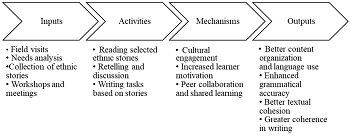
This participatory action research (PAR) study investigated the use of ethnic stories to enhance writing skills among secondary-level ESL learners in Nepal. The study was grounded in culturally responsive pedagogy, and it addressed gaps in traditional writing instruction, which usually depends on foreign stories disconnected from students’ lived experiences. The study was conducted for eight weeks. Participants included 70 students and two teachers who participated in an intervention that integrated ethnic stories into writing tasks. The intervention focused on grammar, organization, coherence, and cohesion. Classroom observation, focus group discussion, and students' writing samples were the primary sources of data collection. Findings showed significant improvements in student engagement and writing proficiency when ethnic stories provided facilitation for structuring their ideas and developing cultural pride. Initial difficulties in formalising oral stories into written formats and teachers’ need for additional training were identified as challenges for teaching writing using ethnic stories. The study focused on the application of ethnic stories in the ESL context, connecting with theories of liberatory education and ethnic studies. The study recommends institutional support for teacher training and expanding such interventions to other linguistic and cultural settings. This research contributes to global conversations on equitable pedagogy by demonstrating how centring students’ identities in curricula can democratise learning and improve academic outcomes.
Review
Abstract views: 1287
PDF downloads: 1029
 Benard Chindia, Sheilla N. Wawire, Harvey Henson
2025-09-15
Pages 318-331
Secondary Science Teacher Preparation: A Scoping Review of Challenges, Structures, and Interventions
Benard Chindia, Sheilla N. Wawire, Harvey Henson
This scoping review synthesizes literature on secondary science teacher preparation programs across five continents, drawing on 22 peer-reviewed studies. It examines program structures, prevailing challenges, and strategies aimed at addressing science teacher shortages, with a particular focus on rural contexts. The countries represented in the review include the United States, Canada, Germany, China, and others from diverse geographic regions. The findings highlight dominant challenges, including shortages of qualified science teachers, technological, pedagogical, and content knowledge (TPACK) gaps, and limited opportunities for interdisciplinary or transdisciplinary training. Shortages are mitigated through lateral/alternative entry pathways and structured programs offering 3--4-year training, combined with clinical experience to enhance TPACK and meet licensure requirements. Some countries train teachers to teach multiple science subjects and provide incentives through scholarships and higher salaries for those who commit to working in rural schools. These findings offer valuable insights for stakeholders, suggesting adaptable strategies to improve the quality and supply of science teachers and strengthen science education.
Abstract views: 58620
PDF downloads: 35404
Satish Prakash Chand
2025-08-04
Pages 303-317
Satish Prakash Chand
Qualitative research offers invaluable tools to explore the depth and complexity of human experiences, social interactions, and contextual influences. This paper examines four central qualitative data collection methods: interviews, focus groups, observation, and document analysis, highlighting their purposes, processes, strengths, and challenges. Interviews facilitate a detailed exploration of individual perceptions and lived experiences, while focus groups leverage group dynamics to uncover collective meanings and social norms. Observation allows researchers to document real-world behaviours, interactions, and contextual factors that participants may be unaware of or unable to articulate. Document analysis provides access to historical, institutional, and personal records, offering naturally occurring data that contextualise and corroborate findings from other methods. This paper also discusses key ethical considerations and the importance of triangulation in enhancing credibility and depth. By integrating these complementary methods, qualitative researchers can construct a nuanced, multidimensional understanding of complex social phenomena, thereby contributing to educational research and broader social science enquiry. This review serves as a practical guide for scholars who are particularly new to qualitative research or those transitioning from quantitative approaches, seeking to harness the richness of qualitative research to investigate human behaviour and meaning-making in diverse contexts.
| ISSN: 2661-4693 Abbreviation: Adv Educ Res Eval Editor-in-Chief: Prof. Sergei Abramovich(USA) Publishing Frequency: Continuous publication Article Processing Charges (APC): Click here for more details Publishing Model: Open Access |